


A custom webhook sends information about Data Quality exceptions to an external system, such as a Zapier workflow, when exceptions are created, updated or closed. This article shows how to create the webhook settings in Timextender Data Platform so you can use them in rule notifications.
Prerequisites
- An external webhook that accepts incoming requests. To create one in Zapier, see Setting Up Custom Webhooks for Notifications with Zapier.
- An admin account. The Integrations tab is only visible to admins, and is not available on services that only orchestrate Data Integration.
Create a custom webhook
- In the bottom-left corner, select your name, then select Settings.
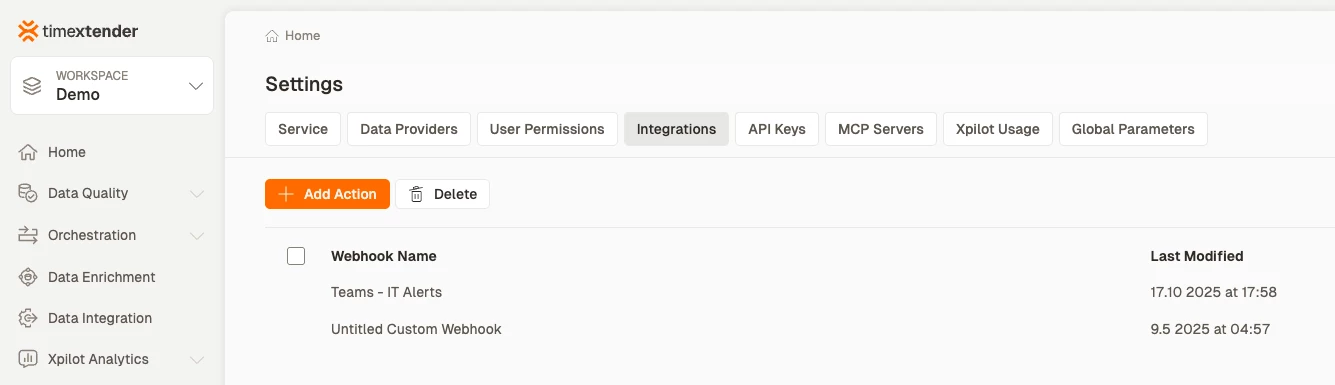
- Go to the Integrations tab.
- Select Add Action.
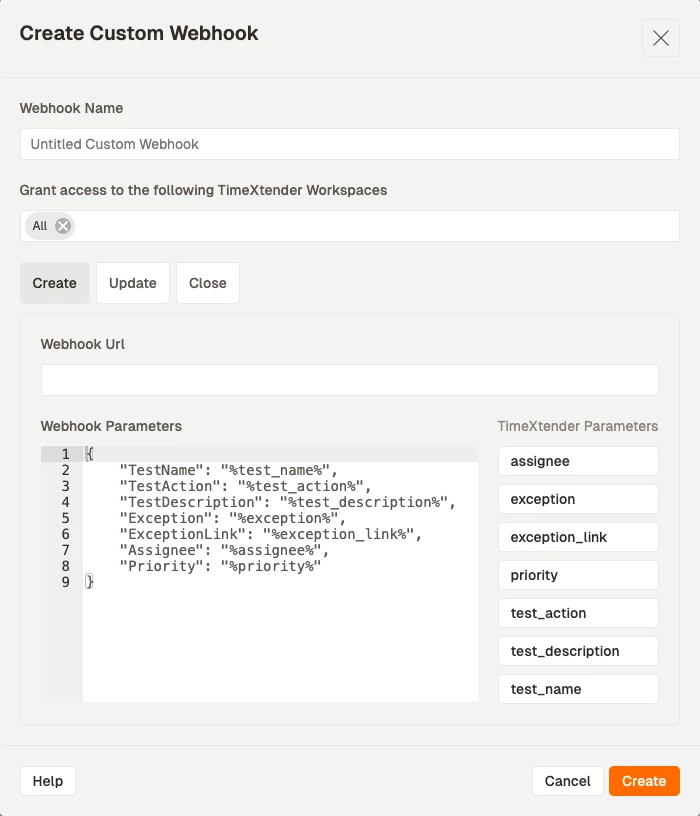
The Create Custom Webhook dialog opens.
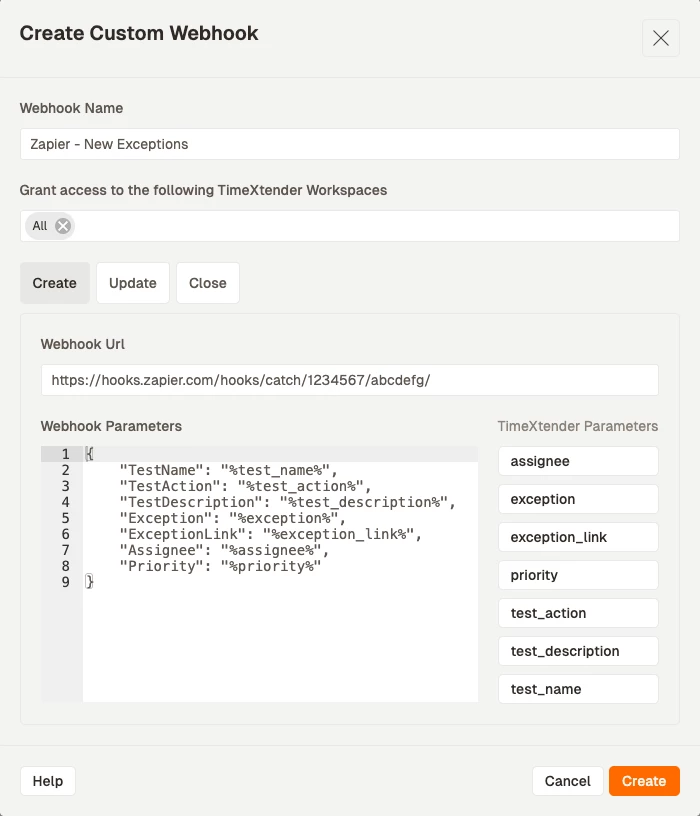
Configure the webhook
- In Webhook Name, enter a name that identifies the webhook. You select the webhook by this name when you add it to a rule.
- In Grant access to the following Workspaces, select the workspaces where the webhook is available. All makes it available in every workspace.
- On the Create tab, enter the external webhook address in Webhook Url. This address is called when a new exception is created.
- In Webhook Parameters, edit the JSON body that is sent to the external webhook. Enter constant values, or select a parameter from the list next to the editor to insert it. Parameters are replaced with values from each exception when the webhook runs.
- To notify an external webhook when an exception is still open, or when it is closed, go to the Update tab or the Close tab and enter its address in Webhook Url. A tab without a URL sends nothing for that event.
- Select Create to save the webhook, or Cancel to discard your changes.
The webhook is added to the list on the Integrations tab. To change it later, select it in the list.
Available parameters
The body must be a flat JSON object with text values. Parameters are written as %name% inside a value.
| Parameter | Value sent |
|---|---|
%test_name% | The name of the rule that found the exception. |
%test_description% | The description of the rule. |
%test_action% | The action defined on the rule. |
%exception% | A summary of the exception. |
%exception_link% | A link to the exception in Timextender Data Platform. |
%assignee% | The full name of the user the exception is assigned to. |
%priority% | The priority of the exception. |
Every request also includes IssueId, TestId, TestType, Uat and NotificationId, so the external system can identify the exception. Requests for open and closed exceptions also include webhook_result_id.
Related articles
- Setting Up Custom Webhooks for Notifications with Zapier
- Creating and Configuring Rules in Turnkey: add the webhook to a rule as a notification.
